 ultimate-guide
How to Choose a Local Family Dentist: A Parent's Guide
Last Updated: November 4, 2026
Quick Summary
To choose a local family dentist, start by mapping each household member's needs, then check the dentist's AHPRA registration, infection control and service range before booking. Compare shortlisted practices side by side on fees, availability, comfort and access, and book a routine check-up for one adult first to see how the visit feels.
- Households that match a practice to their needs tend to stay for years, while those picking the nearest clinic often switch within twelve months.
- Verify any dentist's registration and any conditions on it using the public AHPRA register.
- Ask for a written estimate before treatment and confirm whether the practice is a preferred provider for your fund.
- A look and see appointment with no treatment lets a nervous child explore the chair and ask questions.
- Score each shortlisted practice from 1 to 5 on seven criteria, then total the scores.
Table of Contents
- Start With Your Household's Needs, Not the Nearest Sign
- What to Look for in a Family Dentist
- Questions to Ask a Dentist Before Booking
- Finding a Dentist for Anxious Patients and Children
- Family Dental Check-Up Frequency and What to Expect at Each Visit
- Location, Opening Hours and Access for Every Family Member
- Compare Practices Side by Side Before You Commit
- Book Your Family's First Visit and See How It Feels
- Frequently Asked Questions
Start With Your Household's Needs, Not the Nearest Sign
Choosing a local family dentist works best when you start with your household rather than a map. Households that match a practice to their actual needs tend to stay for years, while those who pick whichever clinic is closest often switch within twelve months. Below, we walk through how to choose a local family dentist step by step, from mapping each member's needs to comparing practices side by side.
A local family dentist is a general dental practitioner who provides ongoing preventive and general care for every member of a household, from toddlers to grandparents, usually from one convenient location. That continuity matters, because a practice that knows your family's history can spot changes early and avoid repeating treatment.
Map each family member's stage of life
Before you shortlist anyone, write down who needs what. Household needs vary enormously across life stages:
- Young children: first check-ups, gentle handling, and preventive advice for parents.
- Teenagers: orthodontic assessment, sports-related protection, and diet guidance.
- Adults: routine check-ups, cleans, fillings, and occasional cosmetic or restorative work.
- Seniors: denture care, gum health monitoring, and support for dry mouth or medication side effects.
A practice that genuinely covers family dental care across all these stages saves you from juggling three clinics. If one provider cannot handle a particular need, ask how they coordinate referrals.
What to Look for in a Family Dentist
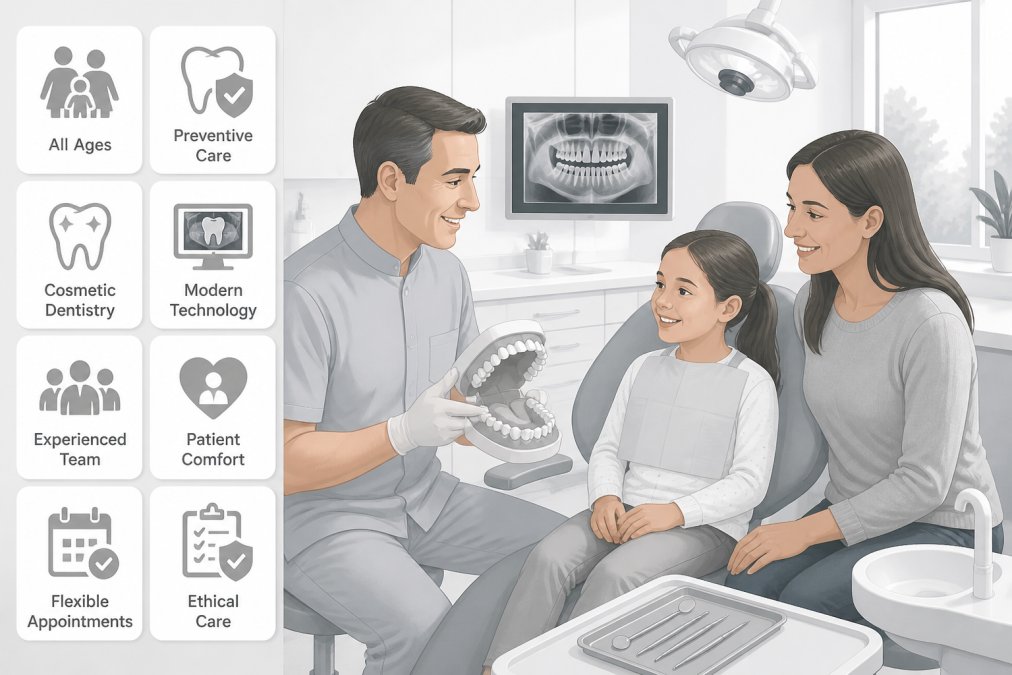
The best family dentist combines three things: current registration, a service range that covers your household, and an environment where nervous patients feel safe. Check all three before you book a first consultation.
Check registration, qualifications and infection control
In Australia, all dental practitioners must be registered with the Dental Board of Australia through AHPRA, the Australian Health Practitioner Regulation Agency. You can verify any dentist's registration and any conditions on it using the public register maintained under the National Registration and Accreditation Scheme. This takes two minutes and is the single most useful check you can make.
Registration alone does not tell you everything. Look for the practitioner's scope of practice, whether they are a general dentist, a specialist, or a limited-registration practitioner, and check for any conditions or undertakings on their registration. If the practice employs hygienists or therapists, ask whether they are also registered and what tasks they perform under the dentist's supervision.
Infection control deserves equal attention. Ask directly how instruments are sterilised and whether the practice uses a validated autoclave with regular monitoring. You can read more about our Latest Technology and Infection Control standards if you want the detail before booking.
Watch out: a practice that cannot tell you what type of autoclave it uses, or that dismisses the question as unnecessary, is a red flag regardless of how convenient the location is.
Services that cover the whole family
A true family practice offers general dentistry, preventive care, children's dentistry, and adult restorative work under one roof. Ask whether they handle dentures for older relatives, emergency appointments, and cosmetic treatments such as whitening, so you are not sent elsewhere for common needs. It is also worth asking how the practice coordinates care when one family member needs a specialist referral, for example, to an orthodontist or oral surgeon, and whether they have established referral pathways that keep the family's records connected.
Questions to Ask a Dentist Before Booking
The right questions to ask a dentist before booking fall into four groups: fees, health funds, availability, and how treatment decisions are made. Ask them on the phone before you commit. A practice that answers clearly and without pressure is usually a good sign.
Fees, health funds and public options
Ask for a written estimate before any treatment and confirm whether the practice is a preferred provider for your fund. Our practice is a preferred provider for Medibank, Bupa and HCF. If you want to understand how cover works before your first visit, our guide to the Family Dental Clinic Health Fund explains the basics. Public dental options may be available to eligible patients, so ask about eligibility if cost is a concern.
Also ask how the dentist handles treatment recommendations. Shared decision-making means you hear the options, the trade-offs, and the cost before anything is booked. Watch out: a practice that recommends extensive work at a first visit without explaining alternatives or showing you the evidence deserves a second opinion.
Finding a Dentist for Anxious Patients and Children
A dentist for anxious patients should prioritise comfort over speed: unhurried appointments, clear explanations, and a genuine willingness to pause. Dental anxiety is common, and a good practice plans for it rather than dismissing it.
Ask how they handle a nervous child's first visit. Many practices use a "look and see" appointment with no treatment, letting the child explore the chair and ask questions. For adults with previous bad experiences, ask whether longer appointments are available and how the team signals a stop if you need one.
Family Dental Check-Up Frequency and What to Expect at Each Visit
The right check-up interval depends on each person's gum health, decay risk and medical history. Your dentist should tell you why they recommend a particular frequency rather than applying one rule to everyone.
A typical check-up includes a dental examination, a professional clean, and a discussion of any changes since last time. Children may also receive fluoride treatment and preventive advice. Ask what is included in the fee and what would cost extra, so there are no surprises.
Location, Opening Hours and Access for Every Family Member
Convenience determines whether routine check-ups actually happen. A practice ten minutes from home, open on Saturdays, and easy to reach by public transport removes the two biggest excuses: time and parking.
Opening hours matter most for working parents. Ask specifically about Saturday availability. If you care for an older relative, check step-free access, parking proximity, and whether the practice can accommodate mobility aids.
Accessibility goes beyond ramps. Ask whether the practice has a ground-floor treatment room, a transfer aid if needed, and accessible toilet facilities. For patients with sensory sensitivities, ask whether the practice can adjust lighting, reduce noise, or offer a quiet waiting area.
Out-of-hours care is the question most families forget until they need it. Ask what happens if a child chips a tooth on a Sunday or a filling fails overnight, and whether the practice offers an emergency line or a referral arrangement for after-hours care.
Finally, consider continuity. If several family members attend the same practice, ask whether you can see the same dentist each visit and how records are shared between clinicians.
Compare Practices Side by Side Before You Commit
A side-by-side scorecard turns a vague feeling into a decision. Score each shortlisted practice from 1 to 5 on the criteria below, then total the scores.
| Criterion | What to Check | Why It Matters |
|---|---|---|
| Registration | Current AHPRA registration for all dentists | Confirms qualifications |
| Infection control | Autoclave type and monitoring records | Safety on every visit |
| Service range | Children, adults, seniors, emergencies | Fewer referrals elsewhere |
| Fees and funds | Written estimates, preferred provider status | Predictable out-of-pocket costs |
| Availability | Saturday slots, regular bookings | Keeps routine care on track |
| Comfort | Anxiety handling, child-friendly approach | Reduces missed appointments |
| Location | Parking, transport, step-free access | Makes attendance easier |
A practice scoring well across all seven is worth a first consultation. One that scores highly on location but poorly on infection control or transparency is not.
Book Your Family's First Visit and See How It Feels
The only real test is the first visit. Book a routine check-up for one adult first, observe how the team communicates, and ask your questions in person. If it feels right, book the children and your partner at the same practice.
At Williamstown Family Dental Group, we offer a preventive approach that avoids unnecessary treatment, and a family-friendly environment built for all ages. Before you book, read what to expect at your first visit, or head straight to our kids' dentistry page to arrange your child's first check-up.
Frequently Asked Questions
What should I look for when choosing a family dentist?
Look for registration with the Dental Board of Australia, experience treating children and older adults, and a practice that offers general dentistry, preventive care and clear treatment advice. Check opening hours, whether Saturday appointments exist, and how fees are explained. Read online reviews for local reputation, and ask about infection-control standards. A practice that treats every family member, from toddlers to grandparents, saves you juggling multiple providers and keeps records in one place.
How can I check a dentist's qualifications and experience?
Search the Australian Health Practitioner Regulation Agency (AHPRA) register to confirm current registration and any conditions. Ask the practice about the dentist's professional experience, continuing education and any special interests, such as children's dentistry or implant work. Accreditation of the practice itself, and a willingness to explain infection-control procedures, are good signs. You can also ask how long the team has worked together, since continuity supports better family dental care.
Can one dentist care for the whole family, including children and seniors?
Yes. A family dentist is trained in general dentistry across life stages, covering routine check-ups, fillings, children's dentistry, and denture care for seniors. Complex cases may be referred to a specialist, which is normal and often a sign of good judgment. Ask whether the practice handles your children's first visits, your parents' dentures and your own preventive care under one roof. That continuity makes records, recalls and treatment planning simpler for everyone.
How often should my family visit the dentist?
Most people benefit from a check-up every six to twelve months, but family dental check-up frequency depends on individual risk. Children with no decay may need only annual reviews; adults with gum disease or a history of fillings may need more frequent visits. Ask your dentist to explain the recall interval they recommend and why. Preventive care, routine examinations and good oral health at home reduce the need for urgent treatment, so keep the schedule your dentist advises.
What should I ask about fees and health fund cover before booking?
Ask for a written schedule of dental fees, whether the practice is a preferred provider for your health fund, and what your out-of-pocket cost is likely to be for a check-up, clean and any treatment. Confirm what your dental insurance covers and whether payment plans exist. Ask about public dental options if you hold a concession card. Transparent pricing and a clear written quote before treatment are reasonable requests at any practice.
How do I find a dentist for anxious patients or nervous children?
Ask directly how the practice manages dental anxiety. Good signs include longer appointment times, a calm and comfortable environment, and staff trained to explain each step before it happens. For children, ask whether the dentist uses a tell-show-do approach and whether first visits are kept short and positive. Reading online reviews from other nervous patients helps. A practice that lets you book a meet-and-greet before treatment can make the first consultation far less daunting.
Choosing a family dentist is a decision you live with for years, so it deserves more than a quick search. If you want a practice that verifies its credentials, explains every option, and treats children and adults with the same care, get started with Williamstown Family Dental Group and book a check-up that suits your family's schedule.