 How-to
How Long Does a Routine Dental Cleaning Take?
Last Updated: November 14, 2026
Quick Summary
A routine dental cleaning usually takes between 30 and 60 minutes of chair time. The exact length depends on your gum health, how much plaque and tartar have built up, and whether it is your first visit or a return appointment.
- The check-up part of a visit is often quick, around 10 to 15 minutes.
- Scaling takes 10 to 20 minutes, with heavier build-up pushing it to the upper end.
- Adding the midpoints of each stage gives roughly 36 minutes of active chair time.
- A deep cleaning often takes 45 to 90 minutes and usually needs two or more visits.
- Most adults benefit from a check-up and clean every six months.
Table of Contents
- How Long Does a Routine Dental Cleaning Take?
- Chair Time Versus Total Time at the Practice
- How Long Does a Dental Check-Up and Clean Take?
- What Happens During a Dental Cleaning
- Routine Dental Cleaning vs Deep Cleaning
- What to Expect After a Dental Cleaning
- Factors That Change How Long a Cleaning Takes
- How to Prepare for Your Cleaning Appointment
- Booking Your Next Routine Dental Cleaning
- Frequently Asked Questions
How Long Does a Routine Dental Cleaning Take?
Most routine dental cleanings take between 30 and 60 minutes of chair time. The exact length depends on your gum health, how much plaque and tartar have built up, and whether it is your first visit or a return appointment.
A routine dental cleaning is a preventive appointment. It removes plaque and hardened tartar from your teeth and gumline, then polishes the surfaces.
Below, we break down the time for each stage, explain what changes it, and show how to prepare.
Chair Time Versus Total Time at the Practice
Chair time is only part of your visit. The cleaning itself may take 30 to 45 minutes, but your total time at the practice is usually longer.
Here is what adds to the clock:
- Check-in and paperwork: a few minutes on arrival, longer for new patients
- A short wait: practices run to schedule, but delays happen
- The examination: your dentist checks teeth, gums and soft tissue
- The cleaning itself: scaling, polishing and flossing
- Aftercare talk: advice on brushing, flossing and your next visit
For a returning patient, the whole appointment often fits inside an hour. New patients usually need longer because of paperwork, a full health history and a more detailed first examination.
If you are weighing up the time and cost of a visit, our guide to understanding out-of-pocket dental costs explains what may be covered and what you might pay.
How Long Does a Dental Check-Up and Clean Take?
A dental check-up and clean usually takes 30 to 60 minutes in total. The check-up part is often quick, around 10 to 15 minutes. The cleaning takes the rest.
The check-up includes:
- A look at every tooth and any fillings or crowns
- A check of your gums and gum pockets
- A soft tissue check of your mouth, tongue and throat
- X-rays if needed, which add a few minutes
If it has been a while since your last visit, or you are unsure whether you need to book, our article on signs you need a dental check-up lists the warning signs worth acting on.
What Happens During a Dental Cleaning
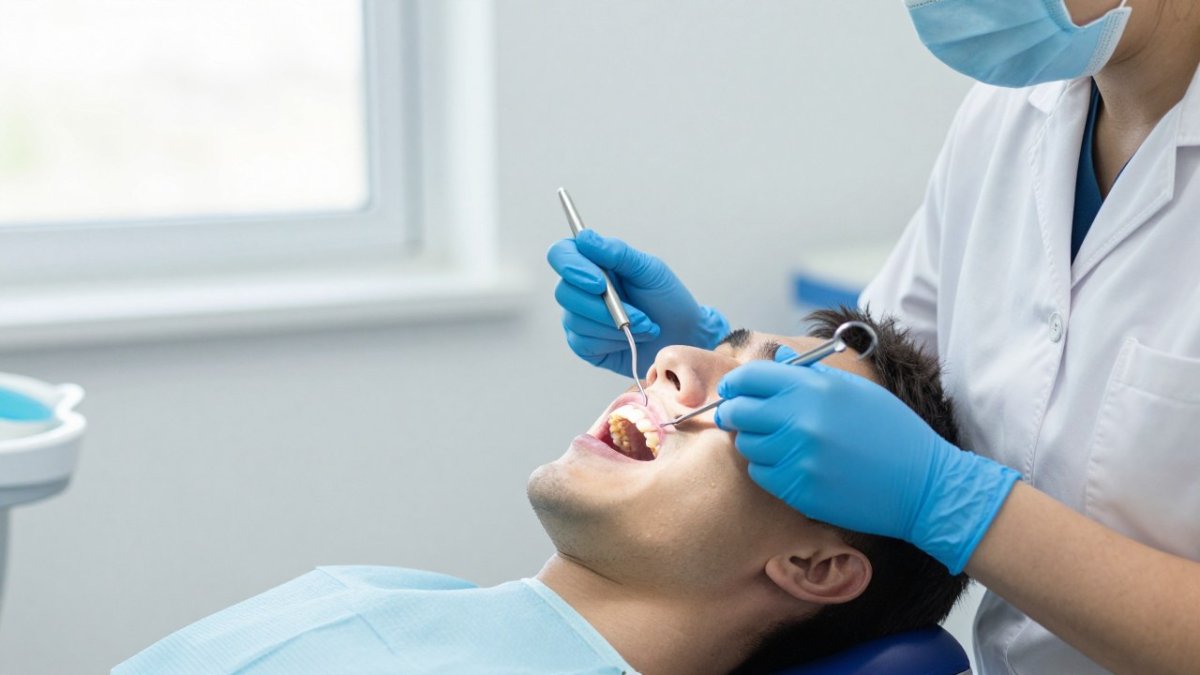
A professional teeth cleaning follows a set sequence. Your dentist or dental hygienist works through the stages below, checking your comfort as they go.
A Stage-by-Stage Time Breakdown
- Initial examination (5 to 10 minutes). Your dentist checks your teeth, gums and soft tissue, noting any areas of concern such as a cracked filling, a tender gum pocket or enamel wear. If X-rays are needed, add another 5 to 10 minutes.
- Scaling (10 to 20 minutes). A hand scaler or ultrasonic tool removes plaque and tartar from above and below the gumline. Your clinician works in sections, so heavy build-up on one side can push this stage towards the upper end.
- Polishing (5 to 10 minutes). A rotating brush and gritty paste smooth the tooth surfaces so plaque is slower to return, and remove surface stains from tea, coffee and red wine.
- Flossing (2 to 5 minutes). Your clinician flosses between each tooth and checks for bleeding gums. Bleeding here is common even in healthy mouths if you have not flossed recently, and it tells your clinician where to focus your home care advice.
- Fluoride treatment (1 to 2 minutes). A fluoride varnish or gel helps strengthen enamel. This is optional and more common for children, people with a history of decay, or those with exposed root surfaces.
- Aftercare advice (2 to 5 minutes). You get tips on brushing, flossing and when to return, and a chance to ask about sensitivity, whitening or anything you noticed during the clean.
How the Stages Add Up
Adding the midpoints of each stage gives roughly 36 minutes of active chair time, comfortably inside the 30 to 60 minute range.
The examination and scaling often take longer than new patients expect, while polishing and flossing are quicker.
If your clinician spends much longer than usual on one area, it may be a stubborn patch of tartar or a gum pocket that needs monitoring, ask them to explain what they found.
Time taken for each stage of a dental cleaning
Routine Dental Cleaning vs Deep Cleaning
A routine dental cleaning is preventive. A deep cleaning treats existing gum disease, so it takes longer and is done in more than one visit.
Deep cleaning, also called periodontal treatment, reaches below the gumline to clear bacteria from gum pockets. Your dentist can explain how it would be carried out for you.
| Feature | Routine cleaning | Deep cleaning |
|---|---|---|
| Purpose | Prevent gum disease | Treat active gum disease |
| Time per visit | 30 to 60 minutes | Often 45 to 90 minutes |
| Visits needed | One | Usually two or more |
| Anaesthetic | Rarely | Often used |
| Comfort | Pressure and mild scraping | Numbness during, soreness after |
| Who it suits | Most adults with healthy gums | Patients with gum pockets and bleeding gums |
If your dentist recommends a deep clean, it is reasonable to ask why.
What to Expect After a Dental Cleaning
Most people feel fine straight after a routine dental cleaning. Your teeth may feel slightly sensitive for a short time after a clean.
Common after-effects include:
- Mild tenderness around the gums
- Slight bleeding when you brush for the first day
- A gritty taste from the polishing paste
- Temporary sensitivity to hot or cold
These usually settle within a few days. If soreness lasts longer, or a tooth becomes painful, ring your practice.
Check any specific aftercare instructions your dentist gives you.
If this is your first appointment with us, our first visit page explains what the overall visit involves and what happens next.
Factors That Change How Long a Cleaning Takes
Several things can stretch or shorten a cleaning.
- Plaque and tartar build-up. Heavy build-up takes longer to remove than a light film.
- Gum health. Bleeding gums and deep gum pockets need more careful, slower work.
- Time since your last visit. A long gap usually means more build-up.
- New patient status. Paperwork and a full first examination add time.
- Crowded or crooked teeth. Tight spaces are harder to clean between.
- Sensitivity or anxiety. If you need breaks, the appointment runs longer.
- Additional treatment. A filling or X-ray found during the check-up adds time.
Nervous patients often worry that their anxiety will slow things down. Tell your dentist at the start, and they can plan extra time and explain each step. Our guide on how to manage dental anxiety has practical ways to make the visit easier.
How to Prepare for Your Cleaning Appointment
A little preparation makes the appointment smoother and can even shorten it. Here is the practical checklist we give patients when they book.
What to Bring
- Your health fund card or member number. If you have extras cover that includes dental, bringing your card lets the practice claim on the spot through HICAPS or a similar terminal, so you only pay the gap. Without it, you may need to pay in full and claim back later.
- A list of your medications. Some medicines, blood thinners, certain blood pressure drugs and some antidepressants, affect bleeding or dry mouth, which in turn affects gum health. Your dentist needs to know before scaling begins.
- Your concession card if you have one. Eligible patients may access public dental schemes or the Child Dental Benefits Schedule, and the practice will need the card to check eligibility.
- Any referral or previous X-rays. If you are transferring from another practice, older X-rays can save time and avoid unnecessary repeat imaging.
What to Do Beforehand
- Brush and floss before you go. Clean teeth are quicker to scale, and flossing the night before gives your gums a chance to settle if they tend to bleed.
- Eat a light meal. You can eat normally after a routine clean, but a light meal means you are not hungry if the appointment runs long. Avoid a heavy meal immediately before if you are prone to gagging.
- Note any problem areas. Write down sore spots, loose fillings, sensitivity or areas that bleed when you brush. It is easy to forget once you are in the chair.
- Arrive a few minutes early. This keeps the schedule on time for everyone and gives you a moment to complete any paperwork without rushing.
- Book a longer slot if you are anxious. Ask when you book, and the practice can allow extra time or schedule you with a clinician who works well with nervous patients.
What to Flag on the Day
- Anxiety or a strong gag reflex. Tell your clinician at the start. They can explain each step, agree a hand signal for breaks, and adjust the order of treatment.
- Sensitivity to cold or sweet. This helps your clinician choose a desensitising polish or fluoride varnish.
- Pregnancy. Routine cleaning is generally safe during pregnancy, but tell your clinician so they can position you comfortably and avoid unnecessary X-rays.
- Recent surgery or a heart condition. Some patients need antibiotic prophylaxis before dental work; your clinician will check your history.
If your appointment is running longer than expected, ask the reception team how much longer it will be. You can also ask to split a long treatment across two visits, a deep clean, for example, is often done one side at a time.
Watch out: do not skip brushing on the day because you think it is pointless before a professional clean. Removing the soft plaque yourself means the clinician can spend the time on the hardened tartar you cannot remove at home.
Booking Your Next Routine Dental Cleaning
Regular visits are an important part of keeping your teeth and gums healthy.
A [Cochrane Oral Health review](Cochrane review on routine scale and polish) looked at six-monthly versus 12-monthly scale and polish.
At Williamstown Family Dental Group, we take a preventive approach. The practice is a preferred provider for Medibank, Bupa and HCF.
We have been established since 2003, we are open on Saturdays, and our team includes Dr Leslie Tu, a University of Melbourne graduate and UCLA-trained implantologist.
Book your next check-up and clean and keep your smile on track.
A healthy mouth starts with a visit you feel good about.
Frequently Asked Questions
How long does a routine dental cleaning take for a new patient?
A first visit usually runs longer than a return visit. That extra time covers a full initial examination, medical history, X-rays if needed, and a thorough clean. Established patients with good oral health often finish in 30 to 45 minutes. If it has been several years since your last professional teeth cleaning, expect closer to the upper end of the range so the hygienist can remove built-up plaque and tartar properly.
Does a dental clean hurt?
Most people feel pressure and vibration rather than pain. Sensitivity is more likely if you have bleeding gums, exposed roots or heavy tartar near the gumline. Tell your dentist or hygienist before the appointment if you are nervous or have sensitive teeth, so they can discuss what options suit you. A routine dental cleaning is a preventive treatment, so speak up early rather than enduring discomfort.
How often should you have a professional dental clean?
Many people attend every six months, but the Cochrane Oral Health review from 2018 found the evidence comparing six-monthly and 12-monthly scale-and-polish treatments on self-reported oral cleanliness was uncertain. That means the right interval depends on your gum health, tartar build-up and history of gum disease, not a fixed rule. Ask your dentist what schedule suits your mouth, and check with your health fund what your cover includes.
Can I eat straight after a dental cleaning?
Yes, in most cases. If your teeth feel sensitive or your gums are tender, take care when eating until any numbness wears off. Avoid very hot, acidic or staining foods and drinks such as coffee, red wine and dark sauces for a few hours, especially after a polish. Drink water, and follow any specific aftercare instructions your hygienist gives you.